
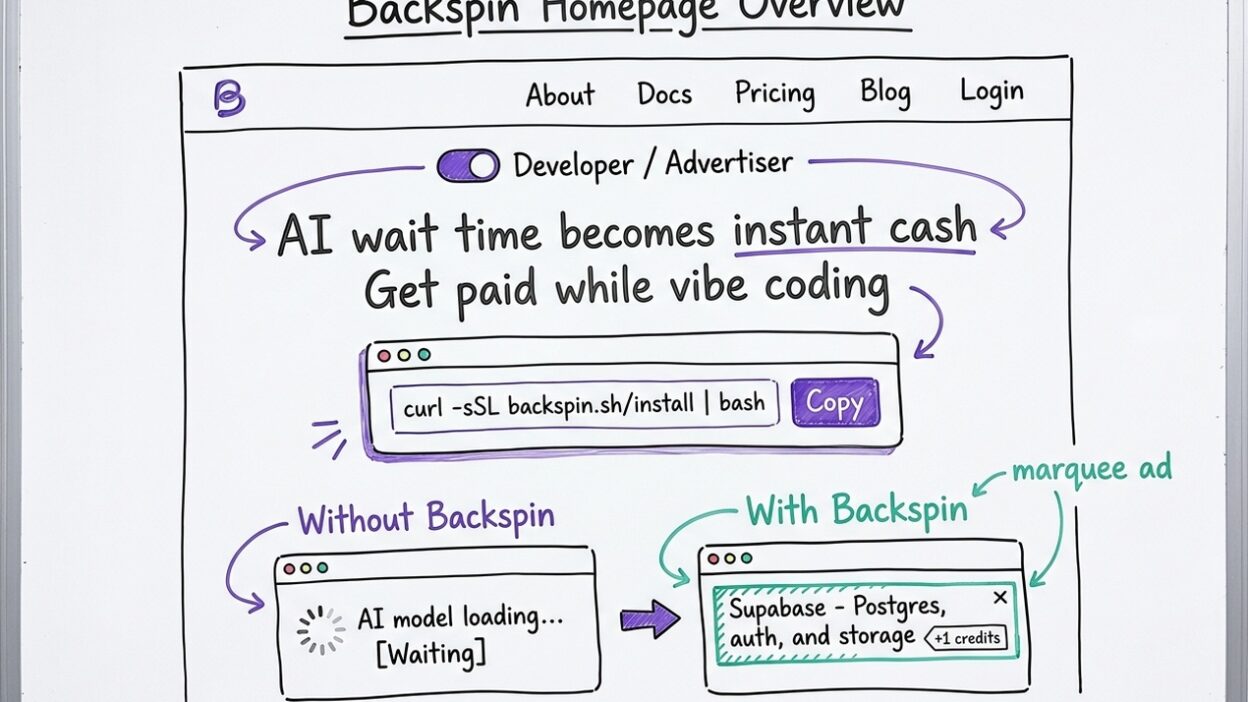
The AI tools spinner just became inventory: publishers earn, advertisers reach. Web3 has spent years promising to pay people for their attention. Tokens for browsing. Points for engagement. Airdrops for “vibes.” Most of it collapsed into farming, bots, and dashboards nobody trusted.
Meanwhile, the most valuable attention in tech was leaking out every single day, unpriced and unnoticed. Developer attention. Specifically, the attention you spend staring at an AI that’s still thinking.
You send a prompt. You kick off a build. You hand a task to an agent. Then you wait. Multiply that across a day of AI-assisted work and it’s a serious block of focused downtime that pays you nothing. I got tired of watching that value evaporate, so I built BackSpin.
Attention as an asset, without the token circus
Here’s the honest part. BackSpin has no token, no points farm, no “engage-to-earn” treadmill. I’ve written before about how much of crypto over-engineers the wrong thing while ignoring the primitive that actually matters, and this is the same lesson. If you’ve read my breakdown of how real-time onchain trading actually works on Hyperliquid, you know my bias: get the core mechanic right first, skip the ceremony.
The core mechanic here is simple. When your AI is working, BackSpin shows one tasteful, relevant discovery, a tool, an MCP server, a grant, a job, or a bounty, and pays you a share of the revenue for the attention. When your AI finishes, it steps aside. That’s the loop. No feed, no popup war, no wallet connect.

Why this is a market, not another ads provider
The web3 attention experiments failed for a boring reason: the attention wasn’t really given, it was gamed. Bots farmed it, and advertisers eventually figured out they were paying for noise.
BackSpin is built as a two-sided exchange instead. Developers opt in and get paid. Advertisers get attention that was genuinely given, in a real moment of downtime, not stolen mid-focus. That single design choice makes the inventory better for the buyer and fairer for the person supplying it. You can see how the revenue split and attention scoring work on how BackSpin works.
If you’ve followed the debates about where value actually accrues in the Ethereum upgrades, this will feel familiar. Value doesn’t accrue to whoever shouts loudest. It accrues to whoever removes friction and builds trust into the base layer. Attention is no different.
Privacy is a hard line, not a disclosure
This is the part I refuse to compromise, and it’s where most attention products quietly cheat.
BackSpin never reads your code, your prompts, or your AI’s responses. It detects that your AI is busy using safe, content-free signals only. Nothing about what you’re building leaves your machine to decide whether to show a card. The lazy way to detect “the AI is working” is to read everything you type and everything the model says back. Plenty of tools do exactly that. I designed that risk out from the start, and the specifics are on the privacy page in plain language.
Opt-in, reversible, and honest about coverage
Every integration ships off until you turn it on, and it uninstalls cleanly with no residue. I’d rather you try it and remove it in thirty seconds than feel trapped.
I’ll be straight about surfaces, because overclaiming is how you lose a technical audience for good. BackSpin works across VS Code and its forks like Cursor, Windsurf, and Kiro, several AI CLIs, MCP hosts, and the browser. Detection quality varies by surface, and some are stronger than others today. We publish the current state on the supported integrations page and update it as coverage improves. If you want to see the card before installing anything, there’s a live demo.
The bigger bet on the future of work
I keep coming back to a theme I’ve written about here before, the way technology is quietly reshaping how and when we actually work. AI didn’t just speed up coding. It inserted thousands of tiny waiting rooms into the day. Those waiting rooms are the new commute: unavoidable, repetitive, and currently worth nothing.
BackSpin’s bet is that this dead time becomes a real, priced market, and that the fair version, opt-in, content-free, reversible, is the one that lasts. The web3 attention economy had the right idea and the wrong incentives. This is the correction.
Try it, then tell me where it breaks
If the “earn during AI waits” idea clicks, install it and push on it hard. If it doesn’t, I want that feedback even more. Developers: which editor or CLI should we make excellent next? Advertisers: who are you trying to reach?
Start from the BackSpin home page, or watch the demo first. We’re also live on Product Hunt at usebackspin.com/launch/ph. And if you want to know who’s behind this, that story is here.